By Tom Macdonald
It’s a good feeling that Boston’s Community Choice Electricity program (CCE) has succeeded over its first 14 months. It’s one compelling piece of evidence that the City is actively in pursuit of climate justice.
CCE’s stated purpose is to increase the amount of renewably sourced electricity Boston residents consume without any increase in monthly bill totals. Last I heard, about 200,000 of Boston’s 300,000 residential and small business electricity accounts are now enrolled in the City’s CCE account. The leverage of bulk purchasing through municipal aggregation has enabled the City to negotiate a choice of three electricity supply rates for CCE enrollees: Basic, Standard, and Green 100. The majority of CCE participants remain enrolled in Standard, the default program tier, which offers a 10% increase above the legally required 20% renewably sourced electricity that Eversource Basic delivers. And the CCE bonus: the relatively small number of CCE participants who have opted-up to Green 100 (CCE’s highest rate tier) are consuming 100% renewably sourced electricity and still paying less than the Eversource Basic rate.
What remains to be accomplished is enrolling the outstanding 100,000 Boston electric accounts which are not yet part of CCE. The City estimates that about 70,000 of these accounts are contracted to competitive or “third-party” electricity supply companies. Many of these competitive suppliers have been called out for their predatory practices in low-income and linguistic minority communities. Their customers are lulled by initially discounted electricity rates into signing contracts whose fine print allows for adjustable rates which become outrageously high.
Having learned to decipher the hieroglyphics of an Eversource bill, I recently encouraged my ESL students to scrutinize their bills. Sure enough, one student’s bill showed that her electricity supplier was neither Eversource nor Constellation (Boston CCE’s supplier) but a company named Clear Choice Energy. And her electric rate? $0.35 per kilowatt hour, over two times more than the Eversource Basic rate ($0.15/kwh) and over three times more than the CCE Standard rate ($0.11/kwh). (The Massachusetts Attorney General’s office estimates that state-wide, average households with third-party supplier contracts are paying an extra $226 per year for their electricity, more than $426 million in total across the state since 2015.)
To switch to Community Choice Electricity, the 70,000 Boston third-party account holders need to either pay a cancellation fee to terminate their contract or exit the third party program at the contract expiration date — but before the company has the chance to (probably automatically) renew their contract. It’s worth noting the City’s estimate: if all 300,000 Boston electricity ratepayers were enrolled in CCE and opted-up to the highest tier rate - Green 100, supplying 100% renewably sourced electricity - Boston’s total CO2 emissions would be reduced by 8%, and at current rates everyone would be saving money on their monthly bills.
The City’s Community Choice Energy office is making an all-out effort to reach maximum CCE enrollment through education and outreach in multiple languages. Locally, the West Roxbury chapter of Mothers Out Front has been active in disseminating CCE information especially through highly informative virtual presentations. Keep a look out for these and attend!
I’ve been to a couple of online presentations in the past couple of months. Becoming informed about the community-centered power of municipal aggregation is in itself a small climate action. Learning enough about CCE to extol its benefits neighbor-to-neighbor-to-neighbor is climate action powerful enough to contribute significantly to City-wide CO2 emissions reduction - all while helping Boston neighbors save money on their electric bill.

Friday, April 29, 2022

Monday, March 28, 2022
Meanwhile, climate change
Freak heat waves and crumbling ice sheets in the Arctic and Antarctic are ominous signs of climate change. Meanwhile, models show that climate change could cause crop yields to plummet faster than expected.
It’s never too late to do something about it. Contact us if you’re interested in acting locally.
It’s never too late to do something about it. Contact us if you’re interested in acting locally.
Thursday, March 3, 2022
No time for incrementalism

The United Nations’ Intergovernmental Panel on Climate Change has released its Sixth Assessment Report, which details how climate impacts are outpacing adaptation efforts.
In an article about the findings, one of the report's authors, Clark University professor Edward Carr, wrote, “Governments have delayed action on climate change for too long, and incremental changes in energy and food production will no longer be enough to create a climate-resilient future.”
With that in mind, consider taking some action here in Massachusetts. People can weigh in on the state’s stretch energy code for newly constructed buildings. Stretch energy codes are locally mandated building codes that require higher energy efficiency than the state’s base building codes. Massachusetts’s 2021 Climate Act orders the Executive branch to produce a local opt-in "net zero" stretch energy code.
Unfortunately, Gov. Baker’s proposal bars municipalities from opting for all-electric in new construction, keeping a place for natural gas.
You can help! Written comments will be accepted until 5 pm on March 9 at stretchcode@mass.gov with the subject line “Stretch Code Straw Proposal Comments.”
Friday, January 7, 2022
From Biden to Wu to you
Happy New Year!
This year is set up to be a productive one for confronting climate change. Though many of the Biden administration’s major climate initiatives are up in the air as congressional Democrats negotiate over the Build Back Better bill, the infrastructure act signed in November takes some significant steps. It includes more than $65 million to upgrade the nation’s electrical grid, a necessary step for supporting renewable energy. It also includes $39 billion to modernize public transit systems, and $7.5 billion to deploy a network of electric vehicle charging stations.
Here in Boston, Mayor Wu has hit the ground running. Two weeks after being sworn in to office, she signed an ordinance requiring the city to divest from fossil fuel companies (as well as tobacco and private prison companies) by the end of 2025. Two weeks after that, she announced lower electricity rates through Boston’s Community Choice Electricity (CCE) program. Through June 30, 2022 (and possibly longer), all tiers of the CCE program, including the 100% renewable Green 100 tier, will have lower rates than Eversource’s Residential Basic Service rate.
Now is a great time to opt in to CCE Green 100. To find out more, join GreeningRozzie and Mothers Out Front for an informational Zoom event, Electricity Providers: Your Wallet, Health and Choices, on Wednesday, January 26 at 7:30 pm.
And check out the many great books about all aspects of climate change and sustainability on GreeningRozzie’s virtual bookshelves at Roslindale’s own cooperative bookstore, Rozzie Bound.
Wednesday, January 5, 2022
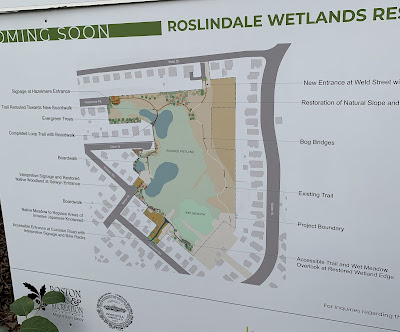
The Roslindale Wetlands Urban Wild – A Moment Worth Remembering
By Tom Mcdonald
Rozzie celebrated a milestone environmental and social justice achievement on Saturday, December 11 at the Roslindale Wetlands Urban Wild. Things have been brewing concerning the wetlands on Walter St. and a piece of local legislative (and environmental justice!) history-in-the-making.
After years of effort, the land at 108 Walter street became part of the Roslindale Wetlands Urban Wild for permanent preservation as open space, with a provision for four units of affordable ownership housing. The Boston City Council voted unanimously to preserve the space in May. And in August the Boston Planning and Development Agency (BPDA) designated Habitat For Humanity Boston as the housing developer.
Though the rain came down hard that Saturday, a hardy crowd of supporters gathered to celebrate the preservation of the Roslindale Wetlands Urban Wild as permanent open space.
We heard rain-shortened but nonetheless gleeful speeches from our community of leaders whose years-long efforts for the Wetlands finally had come to fruition, including Mayor Wu, City Councilors, City Chiefs, and neighborhood activists. They praised the local wetlands flora and fauna, and Roslindale and its amazing residents; and they were encouragingly resolute as they spoke of Boston’s vision for our environmental and social justice future.
Making the City’s Wetlands preservation decision a doubly crowning achievement, the president of Habitat for Humanity (HfH) noted in his turn at the microphone that HfH would be looking for volunteers, possibly in the spring or early summer, to begin building the included abutting four units of affordable housing at 104 Walter with an eye toward reaching net-zero carbon construction standards! For this Greening Rozzer, the Wetlands celebration emanated inspiration and pride of City. It seemed as if even the rain was celebrating….
Kudos to the Roslindale Wetlands Task Force, to the wetlands for hanging-in patiently while waiting for the protection it deserves, and to Boston and Habitat for Humanity for elevating open space and affordable housing!
Let’s keep it coming!
Thursday, September 2, 2021
See where the mayoral candidates stand on environmental issues
Boston-based chapters of Progressive Massachusetts have put together a mayoral candidate survey. Check out what the candidates say about Environment & Transportation issues in section G of each candidate's response:
John Barros
Andrea Campbell
Annissa Essaibi George
Kim Janey
Michelle Wu
Wednesday, September 1, 2021
Help the climate and your wallet – and maybe win a mug
Find out about getting your electricity from the sun, then tell us you did and you could win a GreeningRozzie travel mug!
See how much electricity you can generate from solar panels on your roof – and how much money you’ll earn from generating electricity, how much money you’ll save by not buying electricity and how much credit you’ll get on your taxes.
Enter your information to receive free quotes, including a breakdown of all the numbers, from solar installers screened by EnergySage. If you sign up with one of the installers through GreeningRozzie’s portal on EnergySage’s website and get solar panels on your roof, you'll also get a $250 cash back bonus.
Come see GreeningRozzie at the Roslindale farmers market this Saturday, the 4th, and next Saturday, the 11th. We’ll be sharing a table with Mothers Out Front.
Stop by the table and tell us that you’ve signed up to find out about solar, or email us at info@greeningrozzie.org to enter the drawing for a travel mug.
See how much electricity you can generate from solar panels on your roof – and how much money you’ll earn from generating electricity, how much money you’ll save by not buying electricity and how much credit you’ll get on your taxes.
Enter your information to receive free quotes, including a breakdown of all the numbers, from solar installers screened by EnergySage. If you sign up with one of the installers through GreeningRozzie’s portal on EnergySage’s website and get solar panels on your roof, you'll also get a $250 cash back bonus.
Come see GreeningRozzie at the Roslindale farmers market this Saturday, the 4th, and next Saturday, the 11th. We’ll be sharing a table with Mothers Out Front.
Stop by the table and tell us that you’ve signed up to find out about solar, or email us at info@greeningrozzie.org to enter the drawing for a travel mug.
Subscribe to:
Posts (Atom)